Free GST Bill Format - GST Invoice Template Download
Simple GST bill format for your business to impress your customers. Choose any tally gst format of your choice and Download PDF.
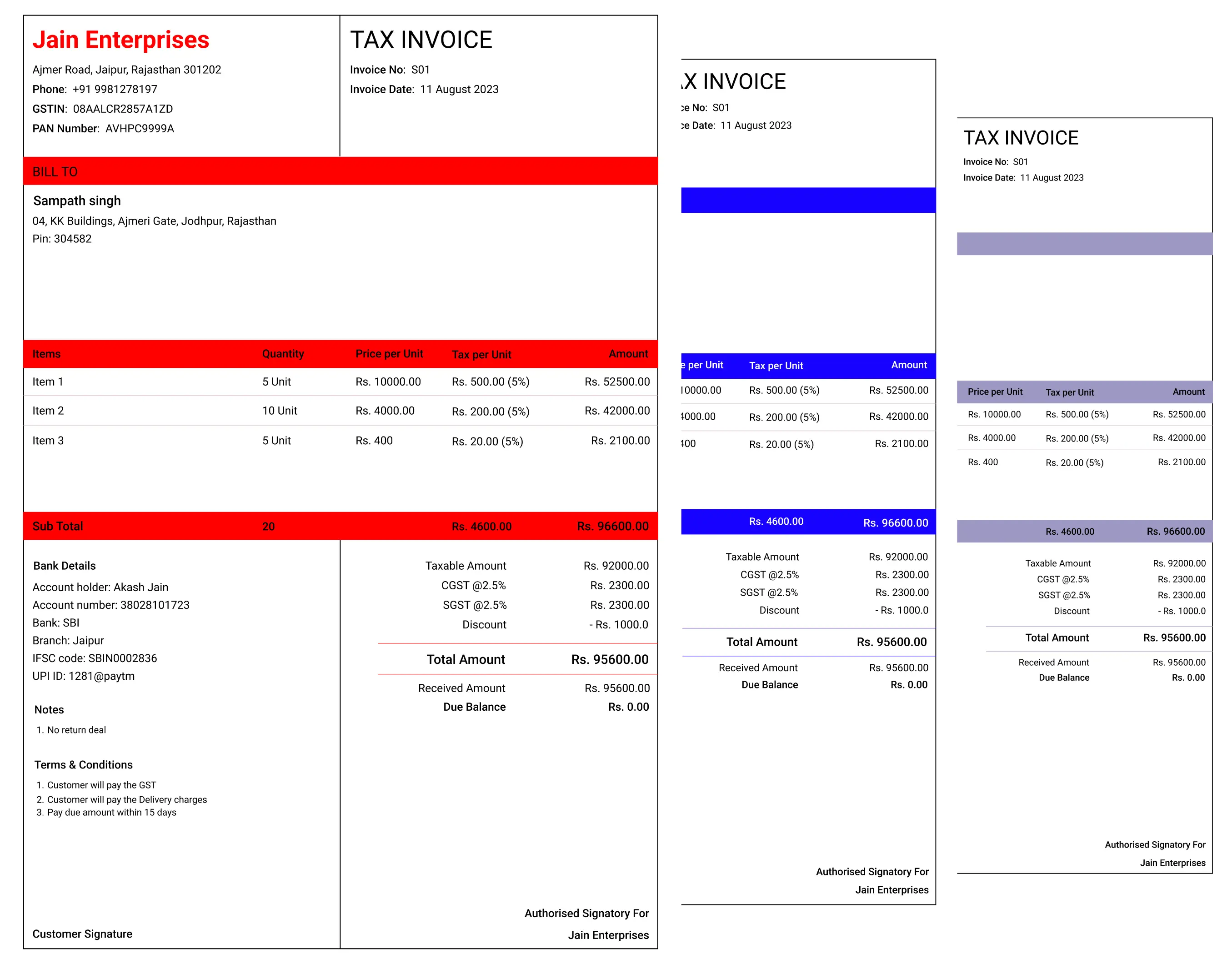
Download Best GST Bill Formats Created For Business
Choose gst invoice format from our template collection.
Download gst bill template or Create free account to make changes according to the need.
GST Bill Format - 1

Download
Tally Bill Format - 1

Download
GST Bill Format - 2

Download
TAlly Bill Format - 2

Download
What is GST Bill Format?
A GST bill format is the prescribed layout for tax invoices issued under India's Goods and Services Tax system. Every business registered under GST must issue a tax invoice in this format for every taxable supply of goods or services. The GST bill serves as the primary document for the buyer to claim Input Tax Credit (ITC) and for the seller to report sales in GST returns.
Before GST was introduced in July 2017, businesses had to deal with multiple tax invoices — VAT invoice, service tax invoice, excise invoice — each with different formats. GST unified all of these into a single invoice format, making billing simpler for businesses across India.
Who Needs to Issue a GST Bill?
- GST-registered businesses — Any business with annual turnover above ₹40 lakh (₹20 lakh for service providers and special category states) must issue GST invoices for every sale.
- E-commerce sellers — Sellers on Amazon, Flipkart, Meesho and other platforms must issue GST invoices regardless of turnover.
- Inter-state sellers — Any business making inter-state sales must have GST registration and issue GST bills, even if turnover is below the threshold.
- Voluntary registrants — Businesses that voluntarily register for GST to claim Input Tax Credit must also issue GST invoices.
A GST bill is different from a bill of supply. A bill of supply is issued by composition scheme dealers or for exempt goods — it does not contain any tax amount. A regular GST bill (tax invoice) must show the tax breakup with CGST, SGST, or IGST amounts separately.
Mandatory Fields in a GST Invoice
Under Rule 46 of the CGST Rules, every GST tax invoice must contain specific details. Missing any of these fields can make the invoice non-compliant and the buyer may lose the ability to claim Input Tax Credit. Here are all 16 mandatory fields your GST bill must include:

Sample GST Tax Invoice — created on Stock Register App
Supplier Details
- Supplier name — Legal name of the business as registered under GST
- Supplier address — Complete address of the place of business
- Supplier GSTIN — 15-digit GST Identification Number
Buyer Details
- Buyer name — Name of the recipient
- Buyer address — Shipping or billing address
- Buyer GSTIN — Required for B2B transactions. For B2C, mention "URP" (Unregistered Person)
- Place of supply — State where goods are delivered or services are consumed. This determines whether CGST+SGST or IGST applies
Invoice Identification
- Invoice number — Unique, sequential number for the financial year (max 16 characters, can contain letters, numbers, and special characters like / and -)
- Invoice date — Date when the invoice is issued
- Due date — Payment due date (optional but recommended)
Item Details & Tax
- HSN / SAC code — HSN code for goods, SAC code for services. Businesses with turnover above ₹5 crore must mention 6-digit HSN codes
- Item description — Clear description of the goods sold or services provided
- Quantity & unit — Number of items with unit of measurement (pieces, kg, litres, etc.)
- Taxable value — Total value of goods/services before tax (after any discount)
- Tax rate & amount — CGST + SGST rates and amounts for intra-state, or IGST rate and amount for inter-state supply
- Total invoice value — Taxable value + tax amount, rounded to the nearest rupee
Tip for small businesses: Manually ensuring all 16 fields are correct on every invoice is time-consuming and error-prone. Use a GST billing software to auto-fill supplier details, calculate tax amounts, generate sequential invoice numbers, and apply the correct HSN codes — so every invoice is GST-compliant by default.
Types of GST Invoices in India
Not every sale requires the same type of invoice under GST. The type of GST invoice you issue depends on your registration type, the nature of the transaction, and whether the supply is taxable or exempt. Here are the main types:
1. Tax Invoice (Regular GST Bill)
This is the standard GST bill issued by every registered dealer for taxable supplies. It contains full tax breakup — CGST + SGST for sales within the same state, or IGST for inter-state sales. The buyer uses this invoice to claim Input Tax Credit.
Used by: All regular GST-registered businesses for B2B and B2C taxable sales
2. Bill of Supply
Issued when the seller cannot charge GST on the invoice. This happens in two cases — when the seller is registered under the Composition Scheme, or when the goods/services being sold are GST-exempt (e.g., fresh milk, unbranded rice, healthcare services). A bill of supply has no tax breakup columns.
Used by: Composition scheme dealers and sellers of exempt goods/services
3. Reverse Charge Invoice
In certain transactions, the buyer pays the GST directly to the government instead of the seller. This is called Reverse Charge Mechanism (RCM). Common examples include purchases from unregistered dealers above ₹5,000 per day, legal services from advocates, and transportation services from goods transport agencies (GTA). The invoice must clearly state "Tax payable under reverse charge."
Used by: Businesses purchasing from unregistered suppliers, legal/GTA services
4. Debit Note and Credit Note
A debit note is issued when the taxable value or tax charged on the original invoice needs to be increased — for example, if items were undercharged. A credit note is issued when the value needs to be reduced — for returns, discounts given after sale, or if excess tax was charged. Both must reference the original invoice number and are reported in GST returns.
Used by: Any GST-registered business correcting previously issued invoices
5. Export Invoice
Issued for goods or services supplied outside India. Export invoices can be issued with IGST (which is later refunded to the exporter) or without tax under a Letter of Undertaking (LUT). The invoice must include the buyer's country, port of loading, shipping bill number, and a declaration that the supply is meant for export.
Used by: Exporters of goods and services
Quick Comparison: Tax Invoice vs Bill of Supply
| Feature | Tax Invoice (GST Bill) | Bill of Supply |
|---|---|---|
| Tax breakup shown | Yes (CGST + SGST or IGST) | No — tax amount cannot be shown |
| ITC claimable by buyer | Yes | No |
| Who issues it | Regular GST-registered dealers | Composition scheme dealers or for exempt goods/services |
| HSN code required | Yes (4 or 6 digit based on turnover) | Yes |
| Place of supply | Mandatory — determines CGST+SGST or IGST | Not required |
| Best for | Most small & medium businesses selling taxable goods/services | Small businesses under composition scheme or selling exempt items |
Create any type of GST invoice in under 2 minutes — with auto tax calculation, HSN codes, and professional templates.
Benefits of Using Stock Register App for GST Invoice Templates
Create professional quotation to impress customers
Add your business details such as business name, address, mobile number, GST number, business logo. Add customer name, address, phone number etc. Add item details such as item name, quantity, price, discount, GST details. Add terms & conditions, notes, signature.
Choose quotation theme & colour of your choice
Choose the quotation theme of your choice from our quotation templates. You can also select the theme colour of your choice to match with brand theme. You can also change the headline colour that can match with your theme colour.
Manage all quotations at one place and track their status
Create and manage sales order, sales quotation, purchase entries at one place. Download or share the quotation with customer. Track the status of unpaid quotation and send reminder to customers.
Automatic stock adjustment on creating quotation
Our inventory management system is connected with quotation management system. Inventory gets adjusted automatically on creating any quotation.
When to Issue a GST Invoice — Time Limits & Rules
GST law specifies strict timelines for issuing invoices. Issuing invoices late can attract penalties and affect the buyer's ability to claim ITC for that tax period.
| Transaction Type | Invoice Must Be Issued | Example |
|---|---|---|
| Supply of goods | Before or at the time of delivery, or before or at the time of removal of goods | A kirana store must give the invoice when the customer picks up the goods or when the goods are dispatched for delivery |
| Supply of services | Within 30 days from the date of supply of service | An IT company completes a project on March 1 — the GST invoice must be issued by March 31 |
| Continuous supply of goods | Before or at the time each payment is due (as per contract) | A wholesaler supplies rice to a restaurant every week on credit, with monthly payment — invoice due each month |
| Continuous supply of services | Before or at the time of payment, or before the due date of payment shown in the contract | Monthly software subscription — invoice must be issued before or on the payment date each month |
| Advance payment received | At the time of receipt of advance (receipt voucher). Full tax invoice at the time of actual supply | A furniture shop receives ₹10,000 advance — issue receipt voucher now, full GST invoice when furniture is delivered |
How Many Invoice Copies to Issue?
- For goods (B2B): 3 copies — Original for buyer, Duplicate for transporter, Triplicate for seller
- For goods (B2C): 2 copies — Original for buyer, Duplicate for seller
- For services: 2 copies — Original for buyer, Duplicate for seller
Minimum Amount for GST Invoice
For B2B sales, a tax invoice is mandatory for every transaction regardless of amount. For B2C sales, the rules are slightly relaxed:
- Sale value above ₹200 — Individual tax invoice required
- Sale value up to ₹200 — You can issue a consolidated invoice at the end of the day for all such sales
Penalty for not issuing GST invoice: Under Section 122 of the CGST Act, failing to issue a GST invoice or issuing an incorrect invoice can attract a penalty of ₹10,000 or the tax amount involved — whichever is higher. For repeated non-compliance, GST registration can be cancelled.
Never miss an invoice deadline or mandatory field again
Stock Register auto-fills your GSTIN, calculates CGST/SGST/IGST, applies HSN codes, and generates compliant GST invoices — ready to download, print, or share on WhatsApp.
Invoice Templates For All Types of Small Businesses
All Useful Formats Used By Small Business
Frequently Asked Questions (FAQs)
What is GST bill format?
A GST bill format (also called GST invoice format) is the standard layout for invoices issued by GST-registered businesses in India. Under GST law, every taxable supply of goods or services must be accompanied by a tax invoice in the prescribed format. It includes seller and buyer details with GSTIN, HSN/SAC codes, item-wise taxable value, CGST, SGST or IGST amounts, place of supply, invoice number, and date. A proper GST bill format ensures compliance and allows the buyer to claim Input Tax Credit (ITC).
What are the mandatory details in a GST invoice?
A valid GST invoice must contain: (1) Supplier name, address, and GSTIN, (2) Invoice number (unique, sequential, max 16 characters), (3) Date of issue, (4) Buyer name, address, and GSTIN (if registered), (5) HSN code for goods or SAC code for services, (6) Description of goods or services, (7) Quantity and unit, (8) Taxable value, (9) Tax rate and amount — CGST + SGST for intra-state or IGST for inter-state, (10) Total invoice value, (11) Place of supply, (12) Signature or digital signature of the supplier.
What is the difference between GST bill and Tally bill format?
There is no legal difference — both follow the same GST invoice rules. "Tally bill format" refers to the invoice layout generated by Tally accounting software, which has a specific look (usually a simple bordered table layout). Stock Register, Vyapar, and other billing software each have their own visual format, but all contain the same mandatory GST fields. You can choose any billing software or template — what matters is that all mandatory GST details are included.
How to download GST bill format in PDF?
You can download ready-to-use GST bill format PDFs from this page — choose from GST Bill Format or Tally Bill Format styles. For creating actual invoices with your business details, use the free invoice generator to fill in your details and download a professional GST invoice PDF instantly. No login required.
What is the difference between CGST, SGST, and IGST on a GST bill?
CGST (Central GST) and SGST (State GST) are charged together on intra-state transactions — when the seller and buyer are in the same state. Each gets half the total GST rate. For example, if GST is 18%, CGST is 9% and SGST is 9%. IGST (Integrated GST) is charged on inter-state transactions — when seller and buyer are in different states. IGST equals the full GST rate (e.g., 18%). Your GST bill format should automatically apply the correct tax type based on the place of supply.
What GST tax rates apply in India?
GST in India has five main tax slabs: 0% (essential items like milk, fresh vegetables, grains), 5% (packaged food, footwear under ₹500, economy hotel rooms), 12% (processed food, mobiles, business class flights), 18% (most goods and services — electronics, restaurants, IT services, financial services), and 28% (luxury items — cars, AC, cement, aerated drinks). Some items also attract additional GST cess (e.g., tobacco, luxury cars). Your GST bill must mention the correct HSN code and applicable rate for each item.
Is it mandatory to issue GST invoice for every sale?
Yes, if you are GST registered, you must issue a GST tax invoice for every taxable supply. For B2B transactions (business-to-business), a full tax invoice with buyer GSTIN is mandatory regardless of amount. For B2C transactions (business-to-consumer), a tax invoice is required for sales above ₹200. For sales below ₹200, a consolidated invoice can be issued at the end of the day. Not issuing proper GST invoices can attract penalties under GST law.
Can I create GST bills on mobile?
Yes. Stock Register App lets you create professional GST invoices directly from your Android phone. Add your business GSTIN, select items with HSN codes and tax rates, and the app auto-calculates CGST/SGST/IGST. Download PDF, print on thermal or A4 printers, or share via WhatsApp. Start with a 7-day free trial — used by 2,00,000+ businesses across India.
Need to track your inventory? Download free stock register format for stock summary, stock entry, and stock value reports.
Manage GST billing and inventory in one app with our stock management software.
Create & Manage GST Bill On Stock Register App
Start your 7 days free trial now. No need to pay up front. Automatic cloud data backup
Trusted by 2,00,000+ small businesses in India. Made in India